
S.3 Ep. 2 | The Critical Filling: 30 Years with Harrington, Peterson & Curtis
Streaming now on: Amazon Music | Apple Podcasts | Spotify | Soundcloud | YouTube
Learn More About Beyond the Endpoint | View All Episodes
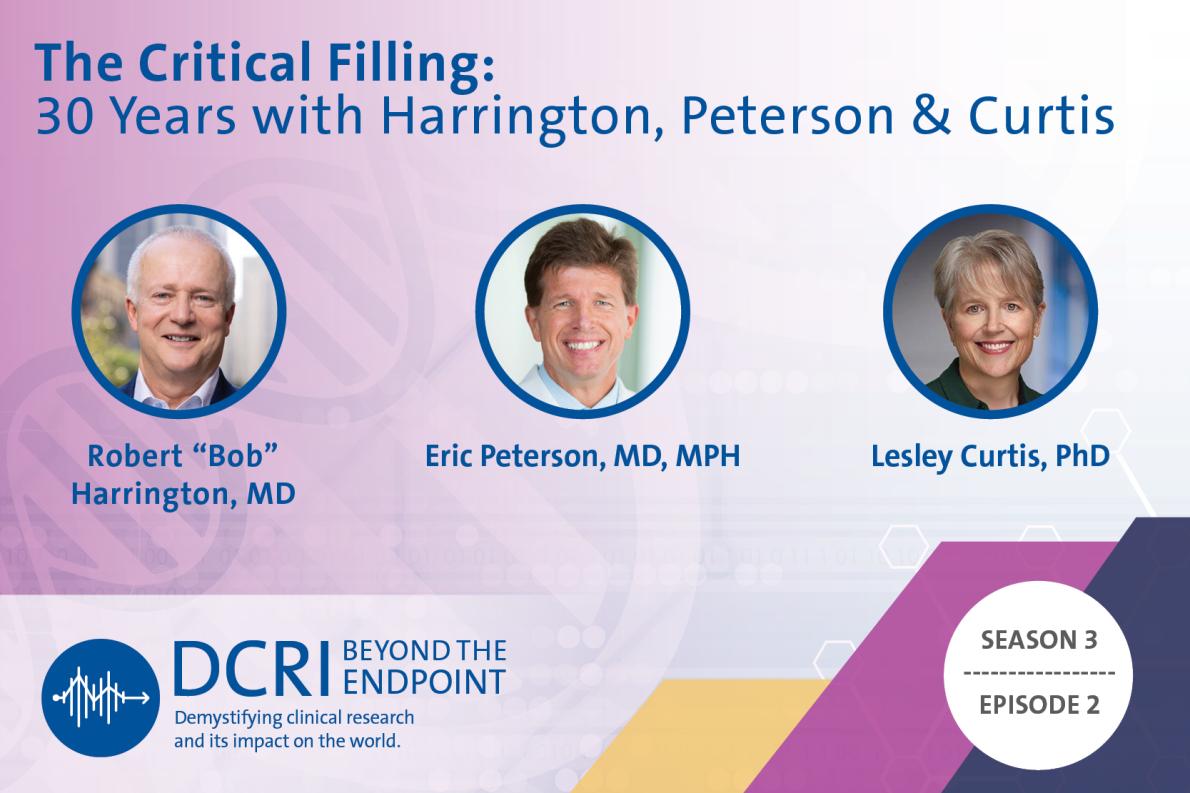
In the second part of the Duke Clinical Research Institute's 30th anniversary series, hosts Manesh Patel and Emily O'Brien welcome the three executive directors who led the institute between its founding and its present day: Bob Harrington, who served from 2006 to 2012, Eric Peterson, who led from 2012 to 2018, and Lesley Curtis, who stepped in as interim director from 2018 to 2020. If part one was the bread, this conversation is the filling. The three reflect on the pressures that defined their tenures, from the 2008 financial collapse and the rise of for-profit contract research organizations to the operational upheaval of COVID-19. They also explore the moments that tested the institute's commitment to publishing findings no matter how inconvenient. The three guests discuss what they built, what they couldn't pull off, and what they believe the DCRI must hold onto as artificial intelligence, global competition, and a changing funding landscape reshape research.
Related Resource
- DCRI’s History: 30 Years and Beyond: Learn about DCRI’s legacy, which is defined by three decades of innovative science, effective partnerships, and reliable results—and by the people who have made it all possible.
- S.3 Ep. 1 | The Foundation & the Future: 30 Years with Califf & Hernandez: Part one of the anniversary series, with founding director Robert Califf and current Executive Director Adrian Hernandez.
About Our Guests

Robert "Bob" Harrington, MD, is a cardiologist who serves as the Stephen and Suzanne Weiss Dean of Weill Cornell Medicine and Provost for Medical Affairs of Cornell University. He led the DCRI from 2006 to 2012 as the Richard Sean Stack, MD Distinguished Professor, a period marked by rapid growth in large-scale global clinical trials and in the institute's fellowship and education programs. Harrington later chaired the Department of Medicine at Stanford University for more than a decade before moving to Weill Cornell Medicine. His research focuses on antithrombotic therapies for acute ischemic heart disease and on improving the methodology of clinical research, including the use of technology to facilitate trials. A past president of the American Heart Association and an elected member of the National Academy of Medicine, he has authored more than 760 peer-reviewed manuscripts, reviews, book chapters, and editorials.
Learn More About Dr. Harrington

Eric Peterson, MD, MPH, is a cardiologist who serves as Vice Provost and Senior Associate Dean for Clinical Research and Vice President for Health System Research at the University of Texas Southwestern Medical Center, where he holds the Adelyn and Edmund M. Hoffman Distinguished Chair in Medical Science. He led the DCRI from 2012 to 2018, a period defined by diversification into new therapeutic areas, the growth of the institute's pediatrics portfolio, expanded partnership with the NIH, and a major investment in national registries. Peterson serves as principal investigator on multiple national registries and large clinical implementation projects and sits on the executive steering committees of several large cardiovascular trials. With more than 1,400 peer-reviewed publications, he ranks among the top one percent of published researchers in clinical medicine.

Lesley Curtis, PhD, is the James B. Duke Distinguished Professor and Chair of the Department of Population Health Sciences in the Duke University School of Medicine, and a member of the DCRI. She served as interim executive director of the DCRI from 2018 to 2020, leading the institute through the onset of the COVID-19 pandemic and the rapid shift to decentralized trials, remote monitoring, and remote operations. A health services researcher by training, Curtis is an expert in the use of health care and Medicare claims data for health services and clinical outcomes research and a leader in national data quality efforts. She is an investigator in the coordinating center for PCORnet and co-principal investigator of the NIH Pragmatic Trials Collaboratory.