
The Duke Clinical Research Institute (DCRI) will lead a national consortium focused on rigorously testing agentic artificial intelligence (AI) tools designed to improve national cardiovascular health, particularly for patients with heart failure.
Known as the SYstematic evaluation and Monitoring of scaled dePloyment and Harmonization of agentic AI tOols to contiNuouslY improve national cardiovascular health (SYMPHONY) Consortium, the collaboration brings together researchers, clinicians, patients, and caregivers from five large health systems with large rural populations, as well as rural health clinics and technology partners to establish a national framework for assessing AI-enabled clinical tools in real-world healthcare settings.
The initiative is supported through an award from the Advanced Research Projects Agency for Health (ARPA-H) as part of its Agentic AI-Enabled Cardiovascular Care Transformation (ADVOCATE) program. The ADVOCATE program aims to develop the first FDA-authorized, artificial agentic intelligence technology that can provide 24/7 specialty care for heart failure. By integrating wearable health monitors, digital health records, and agentic AI that interact continuously, this technology could improve clinicians’ awareness of their patients’ heart health and deliver tailored information and recommendations. Together, the tools will provide real-time guidance that patients and care teams can act on.
The project focuses on addressing heart failure, a condition that affects millions of Americans and remains a leading cause of hospitalization. While advances in digital health technologies have expanded opportunities to support patients and clinicians, healthcare organizations continue to face challenges in evaluating how AI tools can be safely and effectively integrated into clinical workflows and scaled across diverse care settings.
"AI is already reshaping medicine with great promise but little proof. The potential is to reach people where they are, but we need evidence that these tools, when used in care, will improve health. Heart patients deserve tools that have been tested with the same rigor we demand for any drug or device," said DCRI faculty member Manesh Patel, MD, Chief of the Division of Cardiology at Duke University School of Medicine and technical lead for the project. "SYMPHONY is building that evidence and the blueprint that lets any health system, urban or rural, deploy these agents responsibly and ensure the benefits of proven therapies are available to all"
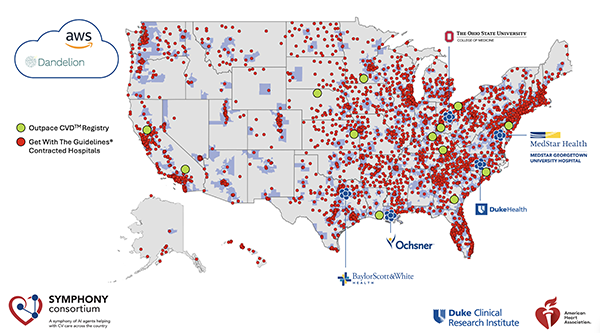
The consortium is led by Duke University and the DCRI in partnership with the American Heart Association (AHA). The consortium includes the AHA, MedStar National Center for Human Factors in Healthcare, Duke Health, Ohio State University Health, Baylor Scott & White Health, Ochsner Health, MedStar-Georgetown, rural health partners in multiple states, and additional collaborators from Amazon Web Services, the Health AI Partnership, and the North Carolina Department of Health and Human Services.
“The SYMPHONY Consortium brings together a highly motivated group that recognizes the potential of AI tools in healthcare but also understands the importance of rigorous assessment for safety and efficacy prior to widespread adoption,” said DCRI faculty member Adam DeVore, MD, MHS, associate professor of medicine and one of the project's co-investigators. “I am excited that we are evaluating these tools in patients with heart failure as we know there are gaps in care, particularly around early access to medical therapy for heart failure, that may be addressed with different care models.”
The consortium's work centers on three goals:
- Putting patients, clinicians, and care teams first. Engaging patients, clinicians, and caregivers from geographically and socioeconomically diverse communities early and continuously in the design of cardiovascular AI agents, so the tools are genuinely usable by the people who depend on them.
- Building on proven frameworks. Leveraging existing governance and integration approaches for agentic AI so new tools align with real clinical workflows and can scale across health systems.
- Holding the tools to a high standard. Rigorously evaluating both the AI agents and their supervisory counterparts against evolving regulatory, evidentiary, and reimbursement standards.
Researchers will evaluate AI technologies designed to support activities such as patient monitoring, care coordination, medication management, and other aspects of heart failure care. Rather than focusing on a single product, the consortium will create processes and infrastructure that can be used to evaluate multiple AI-enabled solutions at scale.
"Evaluating an AI agent isn't a software problem or a medical problem. It's both, and it requires people who can speak to workflow, usability, and clinical evidence in the same conversation," said Sreekanth Vemulapalli, MD, associate professor of medicine at Duke and a project co-investigator. "We've assembled that team, and we're building tools around what patients and clinicians actually need — not around what the technology happens to do well.”
"The challenge here isn't just developing the technology, but making sure it can be safely and effectively integrated into the realities of healthcare delivery," said Rishikesan Kamaleswaran, PhD, associate professor of surgery at the Duke University School of Medicine and program investigator for the consortium. "Our team is building the infrastructure, testing environments, and oversight needed to evaluate these tools in real-world clinical settings. This helps us to ensure they are reliable, cost-effective, and able to support AI-Human care teams at scale.”
The American Heart Association brings assets to SYMPHONY that few organizations can match. It’s Get With The Guidelines® and Outpace CVD™ registries provide real-world benchmarks against which the consortium's AI agents can be evaluated, while the Heart Association’s Precision Medicine Platform offers a secure environment for sharing metadata and study outputs across sites.
"Through SYMPHONY, the Heart Association is helping to ensure that these tools are tested against real-world data, evaluated in a variety of care settings and designed to benefit patients in every community,” said Mariell Jessup, MD, Chief Science and Medical Officer of the American Heart Association and a heart failure cardiologist. “Too often, the patients who could benefit most from new technologies are the last to see them."
About the ADVOCATE Program
ADVOCATE is an ARPA-H program focused on advancing the development, evaluation, and implementation of next-generation AI technologies in healthcare. Duke University's SYMPHONY Consortium serves as a Technical Area 3 performer focused on scaled implementation, evaluation, monitoring, and evidence generation for cardiovascular AI tools.
About the SYMPHONY Consortium
SYMPHONY stands for SYstematic evaluation and Monitoring of scaled dePloyment and Harmonization of agentic AI tOols to contiNuouslY improve national cardiovascular health. The consortium is led by the Duke Clinical Research Institute in partnership with the American Heart Association and a network of health systems, research organizations, and implementation partners across the United States.
About the PIs
SYMPHONY Consortium Principal Investigator: Dr. Manesh Patel, Chief of Division of Cardiology and Clinical Pharmacology, Vice President Heart and Vascular Services Duke University and President, American Heart Association.
SYMPHONY Consortium Co-PI from the AHA: Dr. Mariell Jessup, Chief Science and Medical Officer of the American Heart Association, and Heart Failure Cardiologist
SYMPHONY Consortium Co-PI: Dr. Raj Ratwani, director of the Medstar National Center for Human Factors in Healthcare