
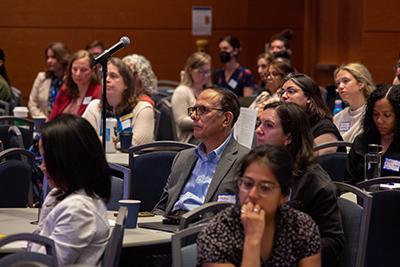
Against the backdrop of two milestone anniversaries, the Duke Clinical Research Institute (DCRI) and Duke Clinical & Translational Science Institute (CTSI) came together to host a research symposium, “Trustworthy Translation – Stories of Today, Visions of Tomorrow,” focused on the practical application of putting evidence into practice to improve health.
The symposium, which took place on May 26 at the Duke Trent Semans Conference Center, honored 20 years since the first Duke Clinical and Translational Science Award and 30 years since the launch of the DCRI. The symposium is part of DCRI’s anniversary campaign, 30 Years & Beyond: Shaping the Future of Clinical Research.
The event brought together researchers, educators, students, clinicians, and community partners from Duke, North Carolina Central University (NCCU), Durham Technical Community College, the Durham community, and beyond to explore a central question: how can scientific discoveries be translated into real-world impact in ways that are worthy of trust and promote health for all?
Sessions were relevant to at least one of the seven symposium topic areas:
- Community-led or community-engaged research;
- Data democratization;
- Dissemination and implementation;
- Health access;
- Learning health systems;
- Team science;
- Trustworthy AI; and
- Workforce innovation.
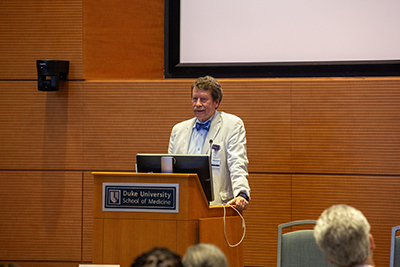
In his keynote address, DCRI Founding Director and two-time FDA commissioner Robert Califf, MD, reflected on both the opportunities and challenges facing the health care system and clinical research.
He highlighted a growing crisis of trust, noting that many Americans feel the health system is not meeting their needs.
“If we don't acknowledge that there are valid concerns that people have had, and reasons they don’t trust the system, we run the risk of not bringing people on board to a better way,” Califf said.
Looking ahead, he urged researchers, clinicians, and community partners to focus not only on generating evidence but on communicating it clearly, addressing misinformation, and working collaboratively to ensure that advances in science actually translate into better health outcomes for all.
He said gatherings like the symposium are a step in the right direction.
“The really good news is that you’re here working on it,” Califf said. “If we work together, we can do something about it."
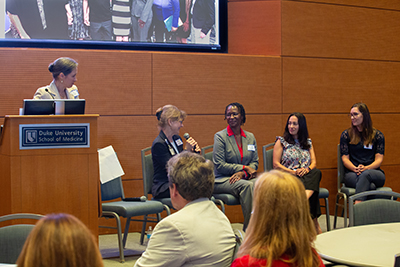
Throughout the symposium, public health leaders and partners moved beyond theory to highlight specific examples of translation being done well, challenges, and work left to be done.
One session focused on hypertension outreach efforts, demonstrating how research can be effectively implemented in community settings. By meeting patients where they are and tailoring approaches to local needs, these efforts illustrated how evidence can be transformed into measurable impact.
While select sessions highlighted specific case studies, the symposium as a whole showcased the breadth of work underway through local universities and the Durham community. Many sessions were led by the community partners.
The audience was especially engaged in a panel discussion focused on the Durham Early College of Health Sciences. This partnership with Duke Health, Durham Technical Community College, and Durham Public Schools provides students with a fast-track pathway into high-paying health care careers.
The symposium also featured one session entirely in Spanish, reflecting the importance of accessibility and inclusion in translational science. English-speaking participants utilized live translation, which was also available for Spanish-speaking participants during the other sessions.
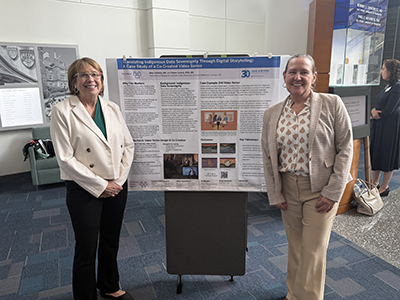
Poster presentations were clustered by themes, allowing attendees to spend time at posters relevant to their work.
The afternoon also featured several interactive workshops focused on trust, partnership, measuring trustworthiness, as well as an interactive data-sharing session called a Participatory Data Walk” as well as a clinical research-themed escape room.
Across keynote remarks, panel discussions, and interactive sessions, there was a clear theme: translation is not a single step but a collective effort that requires collaboration and a deep commitment to patients and communities.
As the symposium concluded, participants reflected on current evidence-based work to improve health and the work that lies ahead. The day served not only as a milestone moment for the DCRI and CTSI, but also as a call to action: continue strengthening the systems, partnerships, and approaches needed to improve health for everyone.