

IGNITE
Welcome to the IGNITE Network
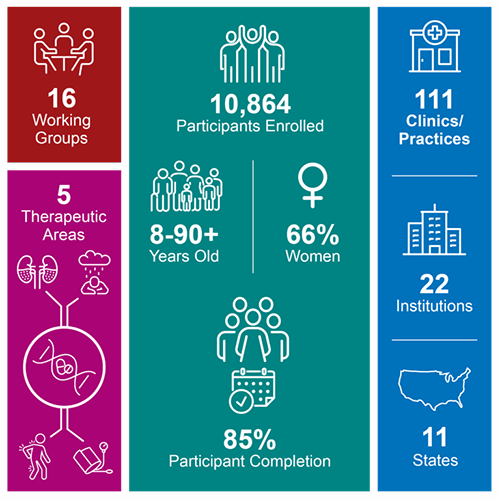
Implementing GeNomics In pracTicE (IGNITE) Network is an NIH-funded network dedicated to supporting the implementation of genomics in healthcare. The network started as IGNITE Genomic Demonstration Projects (IGNITE GDP) and later became IGNITE Pragmatic Trials Network (IGNITE PTN).
Launched in 2013, the initial phase, IGNITE GDP (IGNITE I), focused on a consortium of collaborative genomic medicine pilot projects aimed at demonstrating the feasibility of, and developing methods for, incorporating individual genomic findings into clinical practice.
Building on the success of IGNITE I, the next phase of the network, IGNITE PTN (IGNITE II), began in 2018. This phase features five multi-site clinical groups and one coordinating center that conduct pragmatic clinical trials of genomic medicine interventions across diverse settings and populations. The Protocol Review Committee (PRC), convened by the NHGRI, chose two studies – ADOPT PGx and GUARDD-US – based on their clinical importance, feasibility, potential impact, and cost.
IGNITE Pragmatic Trials Network

The Implementing GeNomics In pracTicE Pragmatic Trials Network (IGNITE PTN), also known as IGNITE II, is an NIH-funded network dedicated to supporting the implementation of genomics in healthcare. The network is comprised of five clinical groups that help promote the mission of IGNITE through support from a coordinating center, working groups (such as the Data and Safety Monitoring Board and Patient/Participant Advisory Board), affiliate members, and an external scientific panel.
Principal Investigators
Christina Wyatt, MD
Professor of Medicine
Core Faculty Member, DCRI
Duke University School of Medicine
Hrishikesh Chakraborty, DrPH
Professor of Biostatistics and Bioinformatics
Director, Pragmatic Clinical Trial Biostatistics, DCRI
Co-Director, Quantitative Core, Center for AIDS Research
Duke University School of Medicine
Indiana University Health
Principal Investigators
Todd Skaar, PhD
Professor of Medicine
Division of Clinical Pharmacology
Indiana University School of Medicine
Paul Dexter, MD
Associate Professor of Clinical Medicine
Division of General Internal Medicine
Indiana University School of Medicine
Mount Sinai
Principal Investigator
Carol Horowitz, MD, MPH
Professor of Medicine and Population Health Science & Policy
Center for Community-Academic Research Partnerships
Icahn School of Medicine at Mount Sinai
Duke University
Principal Investigator
Deepak Voora, MD
Professor of Medicine
Executive Team Member of Duke Center for Applied Genomics and Precision Medicine
Member of the Center for Applied Genomics & Precision Medicine
University of Florida
Principal Investigators
Julie Johnson, PharmD
Professor of Medicine and Pharmacy
Director, Clinical and Translational Science Institute
Associate Dean, Clinical and Translational Science
Associate Vice President for Research
The Ohio State University
Larisa Cavallari, PharmD
Professor of Pharmacotherapy and Translational Research
Co-Director, Center for PGx and Precision Medicine
University of Florida
Vanderbilt University
Principal Investigators
Josh F. Peterson, MD, MPH
Professor of Biomedical Informatics and Medicine
Vanderbilt University
Kerri L. Cavanaugh, MD, MHS
Associate Professor of Medicine
Division of Nephrology and Hypertension
Vanderbilt University

ADOPT PGx
A Depression and Opioid Pragmatic Trial in Pharmacogenomics
Pain and depression are conditions that impact a substantial proportion of the U.S. population, but finding safe, effective drug therapies for both conditions is challenging. ADOPT PGx is a pragmatic clinical trial that enrolls patients into three pharmacogenomics (PGx)-guided therapy scenarios: acute post-surgical pain, chronic pain, and depression. For each scenario, participants will be randomized to genotype-guided drug therapy versus usual approaches to drug therapy selection ("usual care"). Changes in patient-reported outcomes representing pain and depression control using standard patient-reported outcomes measurement information system (PROMIS) scales define the primary endpoints. Secondary analyses include safety endpoints, changes in overall well-being, and economic impact represented by differences in healthcare utilization.
Timeline
February 2021 – May 2024
Design
All three arms are designed as prospective, multicenter, two-arm randomized pragmatic trials to evaluate the impact of pharmacogenetic testing and genotype-guided pain or antidepressant therapy on pain control or depression symptoms.
Intervention / Treatment
Pharmacogenetic Testing
Sponsor
National Human Genome Research Institute (NHGRI)
To assess whether using genotype-guided therapy for acute pain after surgery improves pain control compared to standard care, as measured by a reduction in pain scores using the Silverman Integrated Approach (SIA). For more information about the acute pain trial, visit the ClinicalTrials.gov page: Acute Pain Trial.
PARTICIPATION CRITERIA
- At least 8 years of age or older
- English or Spanish speaking
- Planned or anticipated treatment with tramadol, hydrocodone, or codeine for pain relief after an elective surgery type at an enrolling site (i.e., orthopedic surgeries, open abdominal surgery, cardiothoracic surgery, etc.)
PRINCIPAL INVESTIGATORS
Larisa Cavallari, PharmD
Dean and Distinguished Professor
College of Pharmacy
University of Florida
Julie Johnson, PharmD
Professor of Medicine and Pharmacy
Director, Clinical and Translational Science Institute
Associate Dean, Clinical and Translational Science
Associate Vice President for Research
The Ohio State University
To assess using genotype-guided pain therapy in individuals with at least three months of chronic pain improves pain control compared to standard care. For more information about the chronic pain trial, visit the ClinicalTrials.gov page: Chronic Pain Trial.
PARTICIPATION CRITERIA
- At least 18 years of age or older
- English or Spanish speaking
- History of pain for at least 3 months
- Seen at primary care or pain-relevant specialty clinics
- Currently treated or being considered for treatment with tramadol, hydrocodone, or codeine for pain relief
PRINCIPAL INVESTIGATORS
Todd Skaar, PhD
Professor of Medicine
Division of Clinical Pharmacology
Indiana University School of Medicine
Paul Dexter, MD
Associate Professor of Clinical Medicine
Division of General Internal Medicine
Indiana University School of Medicine
To assess using genetic guidance to dose or select antidepressants in individuals with at least three months of depressive symptoms, who need new or adjusted antidepressant therapy, improves depression management compared to standard care. For more information about the depression trial, visit the ClinicalTrials.gov page: Depression Trial.
PARTICIPATION CRITERIA
- At least 8 years of age or older
- English or Spanish speaking
- Patients followed at psychiatry or primary care clinics at an enrolling site
- Documentation of depression and/or provider report of depression
- Evidence of depressive symptoms for at least 3 months based on patient interview or documentation in patient's medical records
- Recent initiation of SSRI therapy, revised SSRI therapy, or anticipated need for revised or new SSRI therapy per healthcare provider
PRINCIPAL INVESTIGATORS
Josh F. Peterson, MD, MPH
Professor of Biomedical Informatics and Medicine
Vanderbilt University
Kerri L. Cavanaugh, MD, MHS
Associate Professor of Medicine
Division of Nephrology and Hypertension
Vanderbilt University
Delaware
- Nemour's Children's Health System
1600 Rockland Rd, Wilmington, DE 19803
Principal Investigator: Kathryn Blake, PharmD
Florida
- Nemour's Children's Health System
807 Children's Way, Jacksonville, FL 32207
Principal Investigator: Kathryn Blake, PharmD - Nemour's Children's Health System
6535 Nemours Parkway, Orlando, FL 32827
Principal Investigator: Kathryn Blake, PharmD - University of Florida - Gainesville
1225 Center Dr, Gainesville, FL 32610
Principal Investigators: Julie Johnson, PharmD and Larisa Cavallari, MD - University of Florida - Jacksonville
653-1 8th St W, Jacksonville, FL 32209
Principal Investigators: Julie Johnson, PharmD and Larisa Cavallari, MD
Indiana
- Eskenazi Health
720 Eskenazi Ave, Indianapolis, IN 46202
Principal Investigator: Todd Skaar, MD - Indiana University
950 W. Walnut St R2 402, Indianapolis, IN 46202
Principal Investigator: Todd Skaar, MD
New York
- Icahn School of Medicine at Mount Sinai
1 Gustave L. Levy Pl, New York, NY 10029
Principal Investigator: Carol Horowitz, MD - The Institute for Family Health
2006 Madison Ave, New York, NY 10035
Principal Investigator: Neil Calman, MD
North Carolina
- Duke University Medical Center
2301 Erwin Rd, Durham, NC 27710
Principal Investigator: Deepak Voora, MD
North Dakota
- Sanford Health
5225 23rd Ave S, Fargo, ND 58104
Principal Investigator: Lindsay Hines, MD
Tennessee
- Meharry Medical College
1005 Dr DB Todd Jr Blvd, Nashville, TN 37208
Principal Investigator: Rajbir Singh, MD - Nashville General Hospital
1818 Albion St, Nashville, TN 37208
Principal Investigator: Rajbir Singh, MD - Vanderbilt University Medical Center
1211 Medical Center Dr, Nashville, TN 37232
Principal Investigator: Josh Peterson, MD

GUARDD-US
Genetic Testing to Understand and Address Renal Disease Disparities across the U.S.
GUARDD-US is a pragmatic clinical trial that aims to determine the effect of returning Apolipoprotein L1 (APOL1) genetic risk information to hypertensive African ancestry participants and their primary care providers on systolic blood pressure (SBP). The primary outcome is the change in SBP from baseline to three months in participants with high-risk APOL1 variants (positives), comparing those who received results immediately versus those who received results at the end of the trial. APOL1-negative participants in the immediate arm were re-randomized to a genotype-guided approach to anti-hypertensive therapy versus usual care, and three-month SBP was compared between those with immediate return of PGx results and those with delayed return.
Timeline
July 2020 – May 2024
Design
Prospective, multicenter, unblinded, two-arm randomized pragmatic clinical trial. Randomized to immediate (intervention) vs. delayed (control) return of results for positive or negative APOL1 status.
Intervention / Treatment
Diagnostic Test: APOL1 status
Sponsor
National Human Genome Research Institute (NHGRI)
To learn how awareness of a high-risk APOL1 genotype, supported by guideline-based clinical decision support (CDS) for blood pressure management, affects changes in systolic blood pressure (SBP) over three months post-randomization. Secondary outcomes include kidney disease testing and psycho-behavioral factors among participants testing positive for APOL1 within the randomized population. For more information about the GUARDD-US main trial, visit the ClinicalTrials.gov page: Main Trial
PARTICIPATION CRITERIA
- Ages 18-70
- English speaking
- Self-reported African ancestry
- Diagnosed with high blood pressure
PRINCIPAL INVESTIGATOR
Carol Horowitz, MD, MPH
Professor of Population Health Science & Policy and Medicine
Center for Community and Academic Research Partnerships
Mount Sinai Icahn School of Medicine
To assess how knowledge of genetic test results predicting the effectiveness of different blood pressure medications influences changes in SBP from baseline to 3 months in a subset of the individuals who test negative for APOL1. For more information about the GUARDD-US PGx substudy, visit the ClinicalTrials.gov page: GUARDD-US PGx Substudy.
Alabama
- University of Alabama at Birmingham
JT Suite 1235, 625 16th Street South
Birmingham, AL 35294
Principal Investigator: Nita Limdi, PharmD, PhD
Florida
- University of Florida - Gainsville
1225 Center Dr, Gainesville, FL 32610
Principal Investigator: Rhonda Cooper-DeHoff, PharmD - University of Florida - Jacksonville
653-1 8th St W, Jacksonville, FL 32209
Principal Investigator: Rhonda Cooper-DeHoff, PharmD
Indiana
- Eskenazi Health
720 Eskenazi Ave, Indianapolis, IN 46202
Principal Investigator: Michael Eadon, MD - Indiana University
950 W. Walnut Street R2 402
Indianapolis, IN 46202
Principal Investigator: Michael Eadon, MD
Louisiana
- University Medical Center - New Orleans
2000 Canal St, New Orleans, LA 70112
Principal Investigator: Jyotsna Fuloria, MD
New York
- Icahn School of Medicine at Mount Sinai
1 Gustave L. Levy Pl, New York, NY 10029
Principal Investigator: Carol Horowitz, MD - The Institute for Family Health
2006 Madison Avenue, New York, NY 10035
Principal Investigator: Neil Calman, MD
North Carolina
- Southeastern Healthcare
300 West 27th St, Lumberton, NC 28358
Principal Investigator: Joseph Roberts, MD
Pennsylvania
- University of Pittsburgh
205 Salk Pavilion, 335 Sutherland Dr, Pittsburgh, PA 15261
Principal Investigator: Philip Empey, PharmD, PhD
Tennessee
- Meharry Medical College
1005 Dr DB Todd Jr Blvd
Nashville, TN 37208
Principal Investigator: Rajbir Singh, MD - Nashville General Hospital
1818 Albion St, Nashville, TN 37208
Principal Investigator: Rajbir Singh, MD - Vanderbilt University Medical Center
1211 Medical Center Dr
Nashville, TN 37232
Principal Investigator: Kerri Cavanaugh, MD
Texas
- Baylor Research Institute
4500 Spring Ave, Dallas, TX, 75210
Principal Investigator: Heather Kitzman, MD